The Importance of Electrical Safety in Industry


The Importance of Electrical Safety

in Industry

The Importance of Electrical Safety

The importance of electrical safety in industry cannot be overstated. Electrical incidents in the workplace can result in serious injuries, fatalities, and significant property damage. It is essential for employers to provide a safe working environment for their employees and to ensure that all electrical equipment is properly maintained and used in accordance with established safety guidelines.

One of the primary concerns with electrical safety in industry is the risk of electrical shock. This can occur when an individual comes into contact with live electrical equipment or wiring. The severity of an electrical shock can range from a mild tingling sensation to severe burns and even death. To minimize the risk of electrical shock, employers should ensure that all electrical equipment is properly grounded and that employees are trained to identify and avoid hazardous electrical situations.

TOOL BOX TALK MEETING TRAINING


Another concern with electrical safety in industry is the risk of fire. Electrical equipment and wiring can generate a significant amount of heat, and if this heat is not properly dissipated, it can lead to the ignition of flammable materials. To prevent fires, employers should ensure that all electrical equipment is properly ventilated and that employees are trained to identify and respond to potential fire hazards.

In addition to the risk of electrical shock and fire, there are several other potential hazards associated with electrical safety in industry. These include the risk of explosion, the risk of arc flash, and the risk of electrical noise. Each of these hazards can have serious consequences for employees and the workplace, and employers should take steps to minimize these risks.

To ensure electrical safety in industry, employers should implement a comprehensive electrical safety program. This program should include regular employee training, regular equipment inspections and maintenance, and the use of protective equipment such as rubber gloves, safety goggles, and face shields. Employers should also consider implementing safety procedures such as lockout/tagout procedures to prevent incidental activation of equipment.

Human Factors in Industry The Key to a Safe and Secure Workplace

Electrical safety is a critical concern in industry. Employers have a responsibility to provide a safe working environment for their employees and to ensure that all electrical equipment is properly maintained and used in accordance with established safety guidelines. By implementing a comprehensive electrical safety program, employers can minimize the risk of electrical incidents and ensure the safety of their employees.

Another important aspect of electrical safety in industry is the use of proper electrical protection devices such as circuit breakers, fuses, and ground-fault circuit interrupters (GFCIs). These devices are designed to protect against electrical overloads and short-circuits, which can cause fires and electrical shocks. Employers should ensure that all electrical protection devices are properly installed and maintained, and that employees are trained to recognize when they are needed and how to use them correctly.

Employers should also be aware of any relevant electrical safety regulations and standards. For example, in the United States, employers are required to comply with the Occupational Safety and Health Administration (OSHA) regulations for electrical safety in the workplace. These regulations cover a wide range of issues, including the design and maintenance of electrical equipment, the use of protective equipment, and the training of employees.

How Technology and Innovation are 

Transforming HSE

Another important aspect of electrical safety in industry is the use of proper wiring methods. This includes using the right type of wire for the application, securing wires properly, and avoiding hazardous wiring practices such as splicing or using damaged wires. Employers should also ensure that all wiring is properly grounded to prevent electrical shocks.

Regular testing and inspection of electrical equipment is also an important aspect of electrical safety in industry. This includes testing for ground continuity, insulation resistance, and other factors that can indicate a potential hazard. Employers should also keep accurate records of all testing and inspections to ensure that equipment is properly maintained and to identify any potential issues.

In addition to the above, Employers should also ensure that their employees are well-informed about electrical safety. This includes educating employees about the dangers of electrical equipment and wiring, providing training on how to properly use and maintain equipment, and ensuring that employees are aware of proper safety procedures such as lockout/tagout procedures. Employers should also provide employees with access to safety resources such as safety data sheets, emergency evacuation plans, and first aid procedures.

Protecting Your Hands A Guide to Hand Safety and Injury Prevention

Electrical safety is a vital concern in industry. Employers have a responsibility to provide a safe working environment for their employees and to ensure that all electrical equipment is properly maintained and used in accordance with established safety guidelines. By implementing a comprehensive electrical safety program, employers can minimize the risk of electrical incidents and ensure the safety of their employees. Employers should also stay informed about relevant regulations and standards, and ensure that their employees are well-informed about electrical safety.
Another important aspect of electrical safety in industry is the use of Personal Protective Equipment (PPE) such as rubber gloves, safety goggles, and face shields. PPE helps protect employees from electrical hazards such as electrical shocks, arc flash, and electrocution. Employers should ensure that employees are provided with the appropriate PPE and that it is properly maintained and used.

Proper maintenance of electrical equipment is also crucial for electrical safety in industry. This includes regular cleaning, inspecting for damage, and making repairs as necessary. Employers should also ensure that equipment is properly stored and protected from environmental hazards such as moisture, heat, and dust.

Hearing Protection Safety Why It Matters

It's also important to have an emergency plan in place in case of electrical incidents, such as an electrical fire, an electrical shock, or an electrical explosion. This plan should include procedures for emergency shut-off, evacuation, and providing first aid. Employers should also train employees on emergency procedures and conduct regular drills to ensure that everyone is prepared in case of an emergency.

It's also important to note that if an employee is working on electrical equipment or wiring, they should be properly trained, and should have the necessary qualifications to work with electricity safely. This is important to minimize the risk of incidents and to ensure that the work is done correctly.

In addition to the above, Employers should also take steps to minimize the risk of electrical hazards caused by external factors such as natural disasters, power outages, and other unexpected events. This may include installing backup generators, surge protectors, and other equipment to protect against power outages, as well as developing procedures for dealing with natural disasters and other emergencies.

ROAD SAFETY


In conclusion, electrical safety is an essential aspect of industry that requires constant attention, training, and implementation of best practices. Employers have a responsibility to provide a safe working environment for their employees, and to ensure that all electrical equipment is properly maintained, used, and protected in accordance with established safety guidelines. By implementing a comprehensive electrical safety program, employers can minimize the risk of electrical incidents and ensure the safety of their employees.

Chain Pulley Block Safety


Building a Robust Safety Culture: Key Elements and Best Practices


"Building a Robust Safety Culture: 

Key Elements and Best Practices"

Building a Robust Safety Culture: Key Elements and Best Practices

The safety culture of any kind of industry is very important for the Zero Harm in the Workplace. A safety culture is the shared values, beliefs, and attitudes that shape an company’s approach to safety. It is the collective commitment of an company to prioritize the health and safety, well-being of its workers, and to create a safer workplace that is free from hazards and risks. A robust safety culture is essential for the success of any company, as it can help to reduce incidents and injuries, improve productivity, and protect the reputation of the company.

There are several key elements that contribute to a robust safety culture at the workplace:

Commitment from Leadership commitment: A robust safety culture begins at the top, with leadership that is committed to making safety a priority. This means that top management must demonstrate a genuine commitment to safety, and must set an example by following safety protocols and procedures themselves.

Active worker involvement: A robust safety culture requires the active participation and engagement of all workers. This may involve providing opportunities for workers to suggest safety improvements, and encouraging open communication about safety concerns.

Effective safety policies and procedures: A robust safety culture requires clear policies and procedures that outline the expectations for safety in the workplace. These policies and procedures should be communicated to all workers, and should be reviewed and updated regularly to ensure that they are effective.

Chain Pulley Block Safety

Training and communication: A robust safety culture requires ongoing training and education to ensure that workers are aware of the risks and hazards associated with their work, and know how to protect themselves and their colleagues.

Risk assessment and control: A robust safety culture requires the identification and assessment of potential hazards and risks, and the implementation of strategies to mitigate those risks. This may involve conducting regular safety inspections, implementing safety protocols and procedures, and developing emergency response plans(ERP).

Effective Incident investigation & Lesson Learned: A robust safety culture requires the investigation of all incidents and near-misses, in order to identify the root causes and prevent similar incidents from occurring in the future. This may involve gathering information, analyzing data, and implementing corrective actions.

Continual improvement: A robust safety culture requires a commitment to continual improvement, with a focus on identifying and addressing safety gaps and liabilities. This may involve implementing new technologies or practices, or conducting regular safety audits to identify areas for improvement.

 Crane Lifting Hand Signal Guide

A robust safety culture requires the integration of safety into all aspects of the company’s operations, rather than viewing safety as a separate or standalone function. The safety should be integral part of company activities. This may involve integrating safety considerations into decision-making processes, and making safety a key performance indicator for all workers.

Rewards & Recognition pays you the company. A robust safety culture requires the recognition and promotion of safe behaviors, and the identification and correction of unsafe behaviors. This may involve the use of rewards or incentives to encourage safe behaviors, and the implementation of disciplinary measures to address unsafe behaviors.

A robust safety culture requires the creation of a positive safety climate, in which workers feel supported and empowered to speak up about safety concerns. This may involve the establishment of open lines of communication, such as suggestion boxes or anonymous reporting systems, and the creation of a culture of trust and respect.

 Procedure for Fire and Emergency Drill

A robust safety culture requires the establishment of clear lines of responsibility and accountability for safety. This may involve the appointment of a safety officer or team, and the assignment of specific safety responsibilities to all workers.

A robust safety culture requires the integration of safety into the company’s management systems, including the development of safety objectives and targets, and the tracking and measurement of safety performance. This may involve the use of safety metrics, such as injury rates or near-miss reporting, to track progress and identify areas for improvement.

A robust safety culture requires the engagement of all stakeholders, including workers, management, customers, and suppliers. This may involve the involvement of these stakeholders in safety planning and decision-making processes, and the establishment of partnerships with external company’s that have a shared commitment to safety.

 Industrial Workplace Safety | Slip Trip Fall

In summary, a robust safety culture is essential for the success of any company. It requires the commitment of leadership, the involvement and engagement of all workers, clear safety policies and procedures, effective training and education, risk assessment and control, incident investigation & lesson learned, and a focus on continual improvement. By prioritizing safety and building a robust safety culture, company’s can create a safer and healthier work environment for their workers and for the society.

 Height Work Working At Height Basic


Construction Safety Pictorial Guidelines


Construction Safety Pictorial Guidelines


Fire Prevention – Indoor & Outdoor Storage of Materials


Fire Prevention – Indoor & Outdoor

 Storage of Materials

Fire Prevention – Indoor & Outdoor Storage of Materials

Outdoor Storage

Combustible materials shall be properly stacked, taking into consideration the stability of the stack (pile) and shall in no case be higher than 6 m (20 ft). Enough clearance to be maintained.

Ensure the solid combustible materials shall be separated into stacks not larger than 141m3 (5,000 ft3).

Safe Access - Access roads between and around combustible/flammable storage stacks/areas within an outdoor storage yard shall be at least 4.5 m (15 ft) wide and shall be maintained free from any accumulation of rubbish, equipment or other material.

Access roads at storage yards shall be spaced at a maximum grid size of 15 m x 45.7 m (50 ft x 150 ft).

Flammable materials (e.g., paints, fuels, chemicals) shall be stored as per the manufacturer guidelines/Safety Data Sheet(SDS) separated and stored in a designated flammable liquid storage area away from heat sources, electrical equipment and other ignition sources. Container with correct nomenclature is important.

Ensure the incompatible materials (e.g., flammables and oxidizers) shall not be stored together.

Managing Heat Stress in the Workplace : A Complete Guide

Vegetation (e.g., weeds and grass) shall be kept down and a regular procedure provided for periodic cleanup of the entire area. Dry grass is dangerous they can catch fire easily.

Storage areas shall be graded to divert possible spills away from buildings and adjacent working areas, or shall be surrounded by a curb or earth dike at least 30 cm (12 inches) high. The secondary containment to be provided for the required. Provisions shall be made for draining off accumulations of ground/rain water and spills of flammable/combustible liquids when curbs or dikes are used. The required fire protection & fighting arrangement to be done in the storage area with adequate signages including emergency contact numbers.

 Ensuring Safety at Heights in Industry

Indoor Storage

All materials shall be stored and handled according to their fire characteristics, company & local regulations to be referred & ensured.

Incompatible materials that may create a fire hazard shall be segregated by a barrier having a fire resistance of at least 1 hour. SDS recommendations to be ensured.

Safe Access - Material shall be stacked to minimize the spread of fire and permit firefighting access. Aisle space shall be maintained to safely accommodate the widest vehicle that may be used within the building for firefighting purposes.

For building areas/rooms without sprinklers, a minimum clearance of 0.6 m (2 ft) shall be maintained between the ceiling and the top level of any stacked material below.

Ergonomic Safety – Part 2

For building areas/rooms with sprinklers, a minimum clearance of 0.5 m (18 inches) shall be maintained between the top level of any stacked material and the sprinkler heads/deflectors.

Adequate clearance shall be maintained around lights and heating units to prevent ignition of combustible materials.

Combustible/flammable materials shall be maintained at a clearance of at least 0.6 m (2 ft) around fire-rated doors.

Materials shall not be stored/located where they obstruct access to exits or visibility of exit signs. The required fire protection & fighting arrangement to be done in the storage area with adequate signages including emergency contact numbers.

Process Safety Incidents - Case Studies


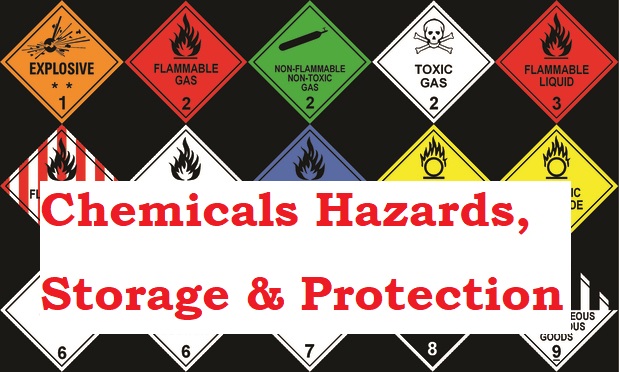
Chemicals Hazards, Storage & Protection


Chemicals Hazards, Storage &

 Protection

Chemicals Hazards, Storage & Protection

Hazardous Area Classification (HAC)

01. Many chemicals are used in industry some of them are may be irritating and result in serious injuries and bums on the face, body, hands, arms, and legs, and also can be flammable, explosive, toxic and result in fire and loss of life. Proper Personal Protective Equipment-PPE‟s must be provided for the employees who are dealing with chemicals. (such as; PVC gloves, aprons, overalls, Breathing Appratus-B.A. and face shield … etc.)

02. All the chemicals shall properly stored as per the Safety Data Sheet-SDS in well ventilated, illuminated, protected, and secured area, away from other materials. Store all flammable chemicals (solvents, petroleum products) separated from other chemicals. Do not store near heat or where strong sunlight will strike them. Provide the required signage in the storage area.

03. All chemical substances shall have their Safety Data Sheet (SDS) available with each store. And the name, characteristics, type of hazard, protection and first aid action clearly displayed on the container label. Provide the basic fire protection in the storage area.

Ergonomic Safety – Part 2

04. Source of clean running water should be available (like; water tapes, eye wash station) for cleaning and diluting the concentration of harmful chemicals (acids, base) splashed on the body, skin, hands or in the eyes as a basic first aid measure.

05 Remove any contaminated clothing immediately and wash the affected part of

the body by large amount of water. Seek the medical help immediately.

06. If employee inhaled large amount of chemical vapours and became unconscious, start artificial respiration. Seek the medical help immediately. Display the emergency contact number in the storage area.

07.Ensure No source of ignition in chemical storage area. No eating or drinking of any type is allowed while using or handling chemical substances. Employees to be trained the safe handling of chemicals.

08. Appropriate number of Fire extinguishers (dry chemical powder or C02) should be available for each chemicals storage area. All employees to be trained on the basic practical firefighting training.

Safeguarding Your Construction Site: A Practical Guide

09. Dilution of Acids - To dilute acids always, add the acid to water NEVER add water to acids. Do not mix acids with solvents and petroleum products. Do not stir acids with metal apparatuses. Use glass ones.

10. Keep floors clean in the chemical storage & handling area, do not allow them to become slippery. In case of spillage or leaks of dangerous chemicals the area shall be cordoned off and the HSE Department notified. Spill kit to be made available in the storage area.

11. If you are in doubt about any chemical, consider it very hazardous and ask your supervisor or ask the HSE Department. Do not store any chemicals in disposable water bottles. Chemical container should be without any labels.

12. Empty containers or bottles, should not be used for domestic or private use and should be disposed off in a safe way as per the company/local government guidelines.

 Hearing Protection Safety Why It Matters